Showing posts with label writing. Show all posts

Sunday, March 5, 2023

Holy Role Models: Saintly Friends and Heavenly Heroes


Children’s role models form their value systems and viewpoints of the world. From toddlers to teens, we want to make sure our kids are surrounded by friends that challenge them to be the person God intends them to be, and in return, we hope that our kids model virtue and inspire the best in others.

How can we help young hearts cultivate friendships? Real-life relationships are crucial, but we also can cultivate friendships with the holy men and women who’ve gone before us: the saints. Through both their prayer and example, the saints are the heavenly heroes we want every kid to emulate.

I shared a collection of ideas about helping kids grow in friendship with the Saints in an article for the National Catholic Register. You can read the whole thing here!

Monday, August 3, 2015

Teaching Faith Using Fairy Tales


Fairy Tales? you might ask.  Aren't those girly, antiquated, and stereotypical?

This past year, I designed a new unit for fables and folk tales, and for the first time, I included fairy tales in the mix.  On one of my long drives, I brainstormed a new way to connect all of these literary styles together as a lesson in finding our faith in all that we do.  I'm not alone in thinking that fairy tales can be a timeless way of teaching children about the battle between good and evil.  Check out these quotes from C.S. Lewis, G.K. Chesterton, and Hans Christian Anderson:

"Since it is so likely that children will meet cruel enemies let them at least have heard of brave knights and heroic courage." ~C.S. Lewis

"Every person's life is a fairy tale written by God's fingers." ~Hans Christian Anderson

"Fairy tales, then, are not responsible for producing in children fear, or any of the shapes of fear; fairy tales do not give the child the idea of the evil or the ugly; that is in the child already, because it is in the world already. Fairy tales do not give the child his first idea of bogey. What fairy tales give the child is his first clear idea of the possible defeat of bogey. The baby has known the dragon intimately ever since he had an imagination. What the fairy tale provides for him is a St. George to kill the dragon. Exactly what the fairy tale does is this: it accustoms him for a series of clear pictures to the idea that these limitless terrors had a limit, that these shapeless enemies have enemies in the knights of God, that there is something in the universe more mystical than darkness, and stronger than strong fear.” ~G.K. Chesterton

I wanted this unit to promote independent thinking and offer student choice.  I collected a large stack of books from my classroom and our school library and set out with this overall plan:
  • Days 1-2: Introduction, notetaking on genres, class example using book Many Moons.
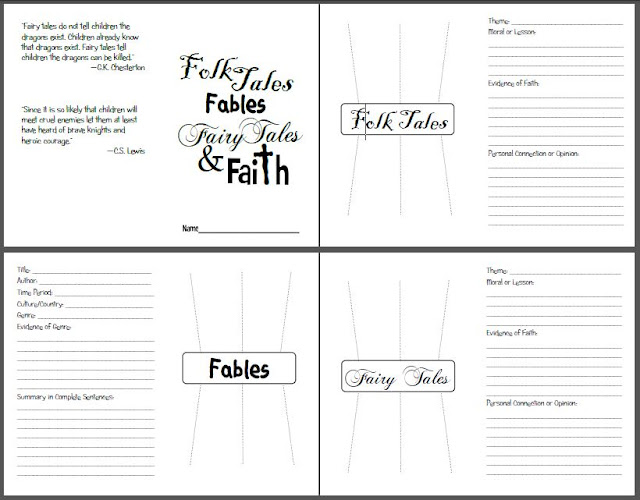
  • Days 3-7: Student and partner choose five books from approved stack, read, and complete a book study on each, recording observations in their unit booklet (printable and key at end of post).  Goal was to complete one book each day, allowing for some students to move a little faster or a little slower.
  • Days 8-9: Assessment strategy using two previously unread books and having students record observations independently to demonstrate understanding.
  • Day 10 and following: Read aloud of The Tale of Despereaux with class discussion of faith elements within.
 
If you are interested in doing a study like this in your classroom, I'd love to share some more details and ideas with you, as well as a list of some of the books we used.  A free printable of the booklet we used throughout the study as well as my "key" is available at the bottom of the post.

On our first two days of study, we had a class discussion about what makes a work of literature fall into the category of fable, folk tale, or fairy tale.  Here are the basic ideas that we include in our notes:

Folk Tales:
  • story passed down by oral tradition from one generation to the next with no known author
  • folk tales are often specific to the traditions of a culture at a certain time and place
  • Plot-involves challenges and rewards, explains the world, gives a moral or lesson
  • Characters- universal (simple) characters, animals, magical
  • Setting- often in general, non-specific locations in the past ("the forest" "a castle")
  • universal but unique- similar folk tales can be seen in many cultures
Fables:
  • folk literature often with animals as characters that teaches a moral or lesson
  • fables often show quick right vs. wrong situations that are rewarded and punished
  • Plot- explains the world, explains origins, contains moral
  • Characters- animals with human characteristics, tricksters
  • Setting- general and happened a long time ago
  • tricksters are often specific animals in a culture- spider, wolf, rabbit, fox
Fairy Tales:
  • folk literature often using royalty and magical people as characters where good wins over evil
  • fairy tales often show a simple, common, or underappreciated character being rewarded and contains a strong sense of good vs. evil
  • Plot- often involves impossible task achieved through virtue or self sacrifice, and sometimes help from a magical source
  • Characters- royalty, magical characters,  common people
  • Setting- often in a magical kingdom long ago
  • often contains- "once upon a time," "happily ever after," patterns of 3s and 7s, lesson/moral
After discussion those three genres, we had a class discussion about finding our faith in everything that we read (and everywhere else as well!).  This unit was taught towards the end of the school year, so we had a year of experiences and discussions to relate back to.  Here were the notes that we took about looking for our faith in what we read:

Finding Faith
  • you should strive to find Christ & your faith in all things, including what you read and watch
  • look for good vs. evil, reward of virtue, morality
  • Plot- look for patterns of 3s, 7s, 40s (and other holy numbers),  make connections to Bible Stories, connections to Sacraments, and look for messages pointing to a greater truth outside of the story
  • Characters- look for people who remind you of people from the Bible, Saints, and Christ
  • Setting- folk tales are often not specific about setting, so you can connect it to any time and place
After completing our notes and discussion, I read aloud the book Many Moons and we found ways to connect this story both to a genre and to our faith. Using that as an example, the kids then chose a partner and were given the task of reading five fables/fairy tales/folk tales over the next five days.  I didn't have any set requirements, but encouraged them to try some from varying genres, monitored the difficulty level of the books and encouraged them to go a little easier/more challenging, and also kept an eye on the length of the books that they were choosing to make it fair.  Groups with a super short book, for example, might then have to read a couple of short stories from a folk tale collection and verbally compare them for me before going on to their next book study.  Again, we did this unit at the end of the year, so they were pretty clear on my expectations for quality work.
Here is a snap of some student work so you can see how they recorded their observations:

After completing their five books with their partners, we used these two books as assessments.  I have used both The Squire and the Scrolland The Princess and the Kiss for kids' retreats at church (A Princess Celebration and Armor of God Retreat), but had not used them specifically in the classroom.  As could be expected, the boys thought that the Princess one was a little too girly for their liking, but they survived. :)  To gauge their understanding of our unit, we used their Reading/Writing notebooks to record observations from the book as I read it outloud.  They could ask me to pause or reread something, but we did not discuss this book until after they had turned in their observations.
 I could have made a printable for this activity, but their notebooks worked just as well.  The split each page into four sections: evidence of genre, evidence of faith, summary, and opinion/connection.  The two evidence sections could be recorded in list form, and the other two had to be in a paragraph.  Here are a few examples of student work:


And finally, during the end of the unit and then continuing after, I used The Tale of Despereaux as a read-a-loud, and the kids loved it. There is so much symbolism to talk about, and the simplicity of the beauty of the story is easy to enjoy.  I also like how the book tells the story of several different characters and then brings all of the narratives together, which is a good structure to model with kids (as it can often be difficult to follow for lower readers).
How can you not be intrigued by the opening page?

We were easily able to find lots of evidence, symbolism, and themes that connected to our faith in the story of Despereaux.  It was a book that the kids enjoyed and was a nice wrap up to our unit.


I think that a unit like this could be taught in many different ways with different levels of kids.  Here are the printables that I used in my classroom.  If you teach a similar unit, especially if you are at a Catholic/Christian School, I'd love to hear how you teach it, what books you recommend, and how you use it to lead the kids to knowing Christ. Chime in down in the comments!


Click on the image below for the printable that you can use with your own students:
https://drive.google.com/file/d/0B5ETRkL51fhMWnhOZDFueEhNdlU/view?usp=sharing

And click here for a scan of my "key" which contains the notes that we took about the genres as well as instructions that I gave the kids for their book studies.


Wednesday, January 28, 2015

Your Handwriting Matters

I am an advocate of handwriting. Handwriting is an undervalued art form, one that's meaning comes from a deeper layer than the words themselves.

When the topic comes up, I always encourage people to use their own handwriting instead of typing/printing/etc.  A sign in their home, a letter, captions in a scrapbook, a birthday invite, addressing wedding thank yous- all in your handwriting.  Many argue with me that their handwriting is messy, that writing is more time consuming, that they just don't like their handwriting.  I think that there is a lot more to it than that...and here are a few reasons why:


1.  Just to be clear, I am not just talking about neat, beautiful, or perfect handwriting.   I am not just talking about teaching "correct" handwriting to my 5th grade students.  I am certainly not just talking about my own handwriting.  I mean that I am an advocate of your handwriting, my handwriting, your children's handwriting- all handwriting. Neatness and penmanship have their place, but as I am writing this post I am thinking about the uniqueness of the way that you write, possible messiness and all.  Your natural handwriting is what others will remember.  When I encourage someone to handwrite something, they often say that it is just because I have great handwriting.  While I will admit that my writing isn't terrible, I certainly don't always like it.  Anytime we are close to something, we often are the first to see its flaws.  I don't typically love my own handwriting, but that doesn't mean that I am not going to use it.  Perfect is not a qualification for sharing a part of yourself. 


2.  Handwriting reveals personality.  I remember using these cheap handwriting analysis books in jr. high to analyze how the slant of my l's revealed that I was an optimist and the curve on the tail of my y's showed that I was an introvert.  I would not put a lot of stock into what official graphology says about you through your handwriting, but just remember on a personal level that your handwriting is a bit of, well, you.  Your personality is carried and emotions can be expressed through handwriting.  Despite the fact that the twenty two students in my classroom have almost all been taught by the same teachers, their handwriting is very unique and I can usually tell their papers apart easily even when they don't have names.  I can also tell when they were in a hurry, when they were confident, and when they were unsure.  I can see them in their writing.

3.  In a world that limits human interactions more and more, handwriting helps us continue to share a bit of ourselves with another.  It allows us to be Incarnational, to show that another is worthy of our time, and to help us see the person behind the communication that we share.  This can be a lot harder through type-written texts, emails, and letters.

4.  Handwriting is sentimental.  Even if you are the opposite of a pack rat, I bet you have a few notes or cards tucked away in a drawer.  You don't keep those cards for the pretty typeface "Happy Mother's Day" on the outside.  You keep it for the scrawled second grader's message printed in pencil on the inside.  Or you keep the note with the spidery cursive that was your grandfather's handwriting near the end of his life.  My dad has some of the worst handwriting I have ever seen (which is saying something as a middle school teacher).  However, the notes that he tapes on my mom's mirror in his terrible handwriting stay there for her to see and mean much more than anything he could have typed.  Being sentimental doesn't mean that we are attached to the object, but to the person behind the object, and it is a good reason to handwrite things that might mean more to someone else.

5.   Handwriting is a little piece of history.  As a genealogy nerd, I savor finding something handwritten by an ancestor. Handwriting is a missing piece of a person's story that can't be recreated after they are gone.  Much like a photograph, that handwriting is unique and important.  Finding original captions on the back of a picture, or a diary penned over time, or a note tucked in a box meant for a loved one from the past is like finding a unique treasure, one that I think we all can appreciate.

6.  Your handwriting is a witness to what you believe.  There is a reason that our signature is still (usually) required to be in our handwriting, even if it is created with a stylus and a digital screen instead of a pen and paper.  Adding your handwriting to something is like adding a stamp of approval, an acknowledgement that testifies to the content of what you are writing.

7.  Finally, handwriting is a connection between the words we live by and who we have been created to be.  "Keep my commandments and live.  Keep my teachings as the apple of your eye.  Bind them on your fingers, write them on the tablet of your heart."  ~Proverbs 7:23


I challenge you to remember that your handwriting matters, that it means something to those around you, and that perfect isn't a requirement for something to be important.  Find ways to incorporate handwriting into your days, and learn to love that you share a bit of yourself with each stroke of the pen.

Sunday, November 16, 2014

Principal Appreciation Day- Thank You Banner

Yesterday, I posted an idea for helping your students show their appreciation to their principal.  Principal's Appreciation Day is Thursday, November 20, 2014.  It always falls on the Thursday before Thanksgiving.   Wanting to tell her "thank you" from my class, we decided to make a Thank You Banner, complete with gratitude notes on the back of the pennant pieces.

You could make the banner in many different ways, but here is how we went about it:

Cut triangles out of cardstock:
If you use 8.5"x11" paper, you can get two pennant pieces (with some waste) if you measure about 2 7/8" from opposite corners of the short side and connect the dots.  Something like this:

I cut enough pennant pieces for each of the students there that day to have.  I also needed one letter for each piece, so some of the pennant pieces were spaces or punctuation.  It all depends on what you want to say and how many students you have!

Each student took their card stock piece and traced it onto normal lined paper.  They cut it out, and then slid it up so that there was a border of cardstock along the two long edges.  They used this as a basis for cutting the top.
On this side the students wrote the principal a gratitude letter.  They included what they appreciated about her, what they have learned from her, etc. 
Then I assigned each student a letter, and they filled the other side with a large bubble letter.  The stars were "spaces"- my way of giving each of the students a part of the project.
I then stapled the pieces in order onto some pretty ribbon.  They would have looked nice sewn together as well- however I didn't have a sewing machine handy that day, so the stapler did the job.

This banner can decorate our principal's office for a while to remind her of how much we appreciate her.  It also would be a great idea for Secretary's Day or Pastor Appreciation Day!

You may also like the gift idea in this post:
http://looktohimandberadiant.blogspot.com/2014/11/principal-appreciation-day-gift-idea.html