Wednesday, August 5, 2015

Katie Makes [2]- Ideas, a tutorial, and a giveaway!


Another Katie Makes post to let you know what I have been up to when it comes to creativity and crafting.  See Katie Makes [1] if you like.

~1~
This post was inspired by a special giveaway I was asked to be a part of!  Right now on Instagram through Friday at 4 p.m. Central Time, you have the chance to win all of these awesome handmade goodies:
I contributed these cute things:
-a 8x10" Scripture print of "Put into the deep" (Luke 5:4) stamped onto a vintage Bible page and matted, ready to frame
-three 5 1/2 x 4 1/4" note cards with "Be who you were meant to be and you will set the world on fire" quote by St. Catherine of Siena decorated with a globe made from repurposed maps
-and a 3" metal gift tag stamped that says "Be Blessed"
You can win those, as well as items from these lovely ladies:

All of them are small business owners with beautiful hand-made things- I encourage you to go visit their shops (and maybe start some early Christmas shopping!)

~2~
Not one to have idle hands, I needed a portable craft project to take with me on our family vacation to Colorado a few weeks ago.  I packed a couple of atlases and a dictionary.  Factor in a couple of Sharpies and many hours of family Netflix watching, and the result was a stack of fifty-some hand lettered frameables. They were pretty popular at the craft sale we had a couple of weekends ago. :)
 It was very relaxing and the perfect traveling project- it did feel a little weird to be tearing up an atlas while driving around a thousand miles from home.

 
~3~
Next project on the docket was a pretty banner for a friend's sister's Bridal Shower.  She is getting married later this fall and her colors are orange and purple.  I had to dig through my stash for those colors (neither usually my favorite) but I really like how the color combination turned out!


  ~4~
 I mentioned in my last post that this metal stamping thing is getting easier.  I found a bunch of these metal tags in silver and copper for a great deal (an awesome deal compared to most metal stamping stuff), and have been stamping some messages on them.  They are about three inches long, so too big for jewelry, but would make cute bookmarks, gift labels, ornaments, basket tags, etc.  However, I am experiencing some writer's block with what to put on them...maybe because stamping in metal is so permanent?  What would you want them to say?  And what would you use them for? (And don't forget you can win one in the Instagram giveaway!)

~5~
 A set of pretty cards including these made up a birthday gift for a friend.  Sitting down with a blank pallet and pretty paper to make cards remains one of my favorite things to do. :)


~6~
 I had a extra canvas from some project a bit ago (so many "extra" craft supplies...) a decided to do a little painting one night.  I love this color combination! I wonder, would it look weird to have a painting hung on a door?  Maybe it would be better in an entryway.

~7~ 
And finally, this sweet little pillow.  At a garage sale a couple of weeks ago, my friend was selling some clothes that she didn't want any more, and among them was this super cute mustard-colored-satin-pleated-skit.  I loved it, but it would have been both too small and too short.  When it was still there at the end of the sale, I bought it off of her with the intentions of making a pillow.  I did it, but it was a little more difficult than I imagined, so I thought I'd share how I made it work in case you want to go thrift store shopping and try one yourself!

I was most excited that the new pillow matched the gold/yellow in the vintage fabric pillows I made last summer!

a. So we start with a skirt.  I had a 16"x16" pillow form that I wanted to use.  The skirt was just the right size horizontally, and was about 18" vertically.
 b. I first cut out the lining so that it wouldn't get in the way.
c. I then cut off the cute tie and set it aside to maybe work in later.  Next I decided how to cover up the side zipper without having to deconstruct the skirt.  I knew I could sew over the teeth of the zipper, but was concerned about the bulky pull and case.  I removed the pull with wire cutters and pliers, left the case about 3/4" from the top, and then covered it all neatly using part of one of the ties.  It was going to work just fine, until I realized that the length of the skirt would allow me to cut the entire waistband off, making the pull and case of the zipper obsolete.  Oh well- just a little wasted time, right?
 d. Next I needed to secure the pleats before sewing the sides of the pillow together.  First I did the easy side with the waistband.  I sewed with the pleats, making sure that the spacing was completely straight and the pleats were parallel to each other.
 Here was the result. I then cut off the waistband.
 e. I then did the same on the hem.  This was a little bit more time consuming because I had to sew slow enough to fold the pleats back.  I worked to keep them straight and parallel, just like on the other side.

f. Here is what the skirt looked like at this point.  And here is where I am going to tell you the mistake I made and how you can avoid it. :) The pillow was currently 16" wide (the original width of the skirt) and would be 16" long after I sewed the two seams.  I did so and put it on the pillow form...and the width was way too big.  I knew that the pleats would cause it to be looser in the middle, but I thought the seams would pull it together, and I was wrong.  The pleats added a lot of volume to the width. So I turned it inside out and cut about 1 1/2" off of each side (parallel with the pleats).
I also decided to reuse the ties that were on the skirt to kind of pull the whole thing together.  I pinned them in the side seems perpendicular to the pleats about 6" from the top.
 g. Cue sewing the "new" side seams and finishing the old ones. Because there was no extra fabric to make this more of a pillow case with a flap in the back to keep it removable, I had to just leave an opening to stuff in the pillow.

 h. To provide for the least amount of hand sewing as possible, I only left about a 6" opening, and also made sure to sew about 2" at the corner to help make closing the seam and having a sharp corner possible.
i.  With such a small opening, I got the pillow in by rolling it tight, forcing it through the opening, and then stretching it out once it was inside.  It took a little longer, but saved many minutes of handsewing.

 j.  The original basting that kept the pleats together and the beginning of the seam at the corner made it easy to fold and pin where I needed to close the seam.  I used a blind stitch to pull it all together.
 k.  And finally, I made a pretty knot with the ties and plopped it in my favorite chair.  It is so cute, and I love that it came from a repurposed skirt!  Upcycling adventures are always fun challenges :)

So, what have you been making lately?  I'd love to hear about it.  And don't forget to head over to Instagram for the giveway!


Monday, August 3, 2015

Teaching Faith Using Fairy Tales


Fairy Tales? you might ask.  Aren't those girly, antiquated, and stereotypical?

This past year, I designed a new unit for fables and folk tales, and for the first time, I included fairy tales in the mix.  On one of my long drives, I brainstormed a new way to connect all of these literary styles together as a lesson in finding our faith in all that we do.  I'm not alone in thinking that fairy tales can be a timeless way of teaching children about the battle between good and evil.  Check out these quotes from C.S. Lewis, G.K. Chesterton, and Hans Christian Anderson:

"Since it is so likely that children will meet cruel enemies let them at least have heard of brave knights and heroic courage." ~C.S. Lewis

"Every person's life is a fairy tale written by God's fingers." ~Hans Christian Anderson

"Fairy tales, then, are not responsible for producing in children fear, or any of the shapes of fear; fairy tales do not give the child the idea of the evil or the ugly; that is in the child already, because it is in the world already. Fairy tales do not give the child his first idea of bogey. What fairy tales give the child is his first clear idea of the possible defeat of bogey. The baby has known the dragon intimately ever since he had an imagination. What the fairy tale provides for him is a St. George to kill the dragon. Exactly what the fairy tale does is this: it accustoms him for a series of clear pictures to the idea that these limitless terrors had a limit, that these shapeless enemies have enemies in the knights of God, that there is something in the universe more mystical than darkness, and stronger than strong fear.” ~G.K. Chesterton

I wanted this unit to promote independent thinking and offer student choice.  I collected a large stack of books from my classroom and our school library and set out with this overall plan:
  • Days 1-2: Introduction, notetaking on genres, class example using book Many Moons.
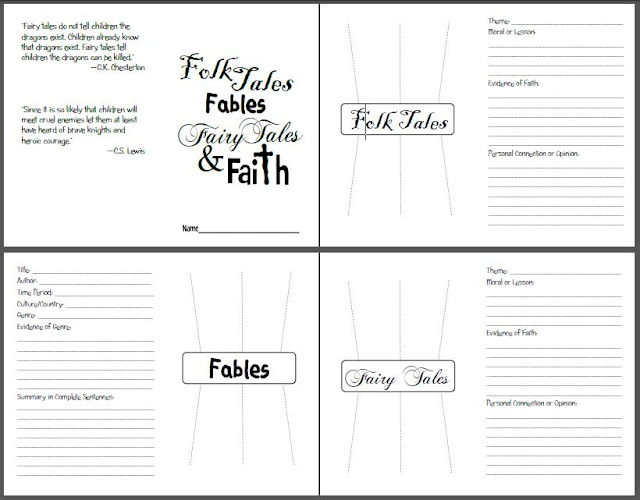
  • Days 3-7: Student and partner choose five books from approved stack, read, and complete a book study on each, recording observations in their unit booklet (printable and key at end of post).  Goal was to complete one book each day, allowing for some students to move a little faster or a little slower.
  • Days 8-9: Assessment strategy using two previously unread books and having students record observations independently to demonstrate understanding.
  • Day 10 and following: Read aloud of The Tale of Despereaux with class discussion of faith elements within.
 
If you are interested in doing a study like this in your classroom, I'd love to share some more details and ideas with you, as well as a list of some of the books we used.  A free printable of the booklet we used throughout the study as well as my "key" is available at the bottom of the post.

On our first two days of study, we had a class discussion about what makes a work of literature fall into the category of fable, folk tale, or fairy tale.  Here are the basic ideas that we include in our notes:

Folk Tales:
  • story passed down by oral tradition from one generation to the next with no known author
  • folk tales are often specific to the traditions of a culture at a certain time and place
  • Plot-involves challenges and rewards, explains the world, gives a moral or lesson
  • Characters- universal (simple) characters, animals, magical
  • Setting- often in general, non-specific locations in the past ("the forest" "a castle")
  • universal but unique- similar folk tales can be seen in many cultures
Fables:
  • folk literature often with animals as characters that teaches a moral or lesson
  • fables often show quick right vs. wrong situations that are rewarded and punished
  • Plot- explains the world, explains origins, contains moral
  • Characters- animals with human characteristics, tricksters
  • Setting- general and happened a long time ago
  • tricksters are often specific animals in a culture- spider, wolf, rabbit, fox
Fairy Tales:
  • folk literature often using royalty and magical people as characters where good wins over evil
  • fairy tales often show a simple, common, or underappreciated character being rewarded and contains a strong sense of good vs. evil
  • Plot- often involves impossible task achieved through virtue or self sacrifice, and sometimes help from a magical source
  • Characters- royalty, magical characters,  common people
  • Setting- often in a magical kingdom long ago
  • often contains- "once upon a time," "happily ever after," patterns of 3s and 7s, lesson/moral
After discussion those three genres, we had a class discussion about finding our faith in everything that we read (and everywhere else as well!).  This unit was taught towards the end of the school year, so we had a year of experiences and discussions to relate back to.  Here were the notes that we took about looking for our faith in what we read:

Finding Faith
  • you should strive to find Christ & your faith in all things, including what you read and watch
  • look for good vs. evil, reward of virtue, morality
  • Plot- look for patterns of 3s, 7s, 40s (and other holy numbers),  make connections to Bible Stories, connections to Sacraments, and look for messages pointing to a greater truth outside of the story
  • Characters- look for people who remind you of people from the Bible, Saints, and Christ
  • Setting- folk tales are often not specific about setting, so you can connect it to any time and place
After completing our notes and discussion, I read aloud the book Many Moons and we found ways to connect this story both to a genre and to our faith. Using that as an example, the kids then chose a partner and were given the task of reading five fables/fairy tales/folk tales over the next five days.  I didn't have any set requirements, but encouraged them to try some from varying genres, monitored the difficulty level of the books and encouraged them to go a little easier/more challenging, and also kept an eye on the length of the books that they were choosing to make it fair.  Groups with a super short book, for example, might then have to read a couple of short stories from a folk tale collection and verbally compare them for me before going on to their next book study.  Again, we did this unit at the end of the year, so they were pretty clear on my expectations for quality work.
Here is a snap of some student work so you can see how they recorded their observations:

After completing their five books with their partners, we used these two books as assessments.  I have used both The Squire and the Scrolland The Princess and the Kiss for kids' retreats at church (A Princess Celebration and Armor of God Retreat), but had not used them specifically in the classroom.  As could be expected, the boys thought that the Princess one was a little too girly for their liking, but they survived. :)  To gauge their understanding of our unit, we used their Reading/Writing notebooks to record observations from the book as I read it outloud.  They could ask me to pause or reread something, but we did not discuss this book until after they had turned in their observations.
 I could have made a printable for this activity, but their notebooks worked just as well.  The split each page into four sections: evidence of genre, evidence of faith, summary, and opinion/connection.  The two evidence sections could be recorded in list form, and the other two had to be in a paragraph.  Here are a few examples of student work:


And finally, during the end of the unit and then continuing after, I used The Tale of Despereaux as a read-a-loud, and the kids loved it. There is so much symbolism to talk about, and the simplicity of the beauty of the story is easy to enjoy.  I also like how the book tells the story of several different characters and then brings all of the narratives together, which is a good structure to model with kids (as it can often be difficult to follow for lower readers).
How can you not be intrigued by the opening page?

We were easily able to find lots of evidence, symbolism, and themes that connected to our faith in the story of Despereaux.  It was a book that the kids enjoyed and was a nice wrap up to our unit.


I think that a unit like this could be taught in many different ways with different levels of kids.  Here are the printables that I used in my classroom.  If you teach a similar unit, especially if you are at a Catholic/Christian School, I'd love to hear how you teach it, what books you recommend, and how you use it to lead the kids to knowing Christ. Chime in down in the comments!


Click on the image below for the printable that you can use with your own students:
https://drive.google.com/file/d/0B5ETRkL51fhMWnhOZDFueEhNdlU/view?usp=sharing

And click here for a scan of my "key" which contains the notes that we took about the genres as well as instructions that I gave the kids for their book studies.